Bid adjustments represent one of the most underutilized yet powerful levers in your Google Ads campaigns. While most advertisers treat them as simple percentage modifiers, the reality is far more complex. Recent research from Walmart's advertising optimization team reveals that geographic bid adjustments can unlock significant revenue potential when properly implemented, demonstrating clear RPM (Revenue Per Mille) separations across different market segments.
This comprehensive guide will equip you with the mathematical frameworks and analytical processes needed to transform bids in Google Ads from reactive tactics into predictive competitive advantages.
Bid adjustments allow advertisers to increase or decrease their base bids based on specific targeting criteria. Unlike the surface-level explanations found in Google's documentation, the strategic implementation of adjustments requires understanding their interaction with auction dynamics and conversion probability distributions.
At its core, adjustments operate through multiplicative bidding mechanisms, where your final bid equals the base bid multiplied by all applicable adjustment factors. However, this simple mathematical relationship masks complex behavioral patterns that can be exploited for competitive advantage.
The effectiveness lies in their ability to capture heterogeneous value distributions across different audience segments. Consider this fundamental equation:
Final Bid = Base Bid × Device Adjustment × Location Adjustment × Time Adjustment × Audience Adjustment
This multiplicative structure creates exponential scaling effects. For example, if you increase bids a +20% mobile adjustment, +15% location adjustment, and +25% audience adjustment, your effective bid increase becomes 58% (1.2 × 1.15 × 1.25 = 1.725), not the 60% you might expect from simple addition.
A comprehensive analysis of device-specific user behavior reveals critical differences in engagement patterns that directly impact device bid adjustments effectiveness. The goal is to reach devices where users are most valuable. Research shows mobile users account for 63% of site traffic during ad campaigns, while desktop users represent 92% of traffic from direct and organic searches.
Geographic targeting in the Search Network represents one of the most data-rich opportunities for bid optimization. Choosing a specific location or even certain locations for showing ads is critical. For example, Walmart's dimensional bidding study demonstrated that combining multiple bid adjustments achieved a 2% increase in ROAS for their Campaign, with conversion rates increasing from 11.12% to 11.23%.
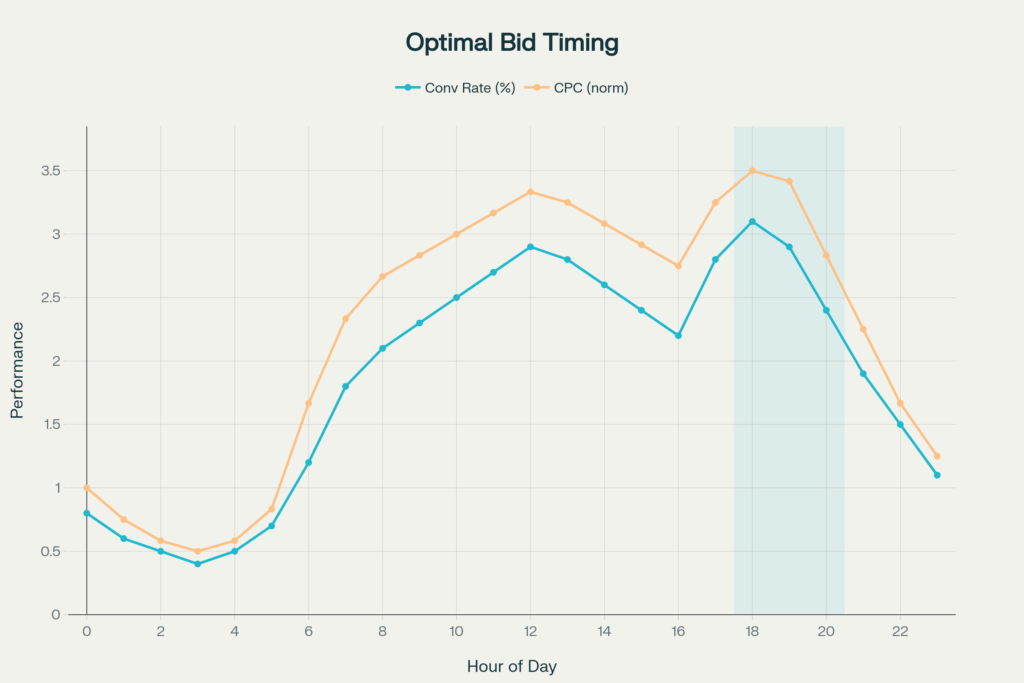
Time-of-day bidding patterns, managed through ad scheduling, emerge as a crucial factor in Campaign optimization. Research shows distinct cost and performance variations throughout daily cycles for search ads. The impression supply during prime hours is significantly higher than other periods, leading to cost and profitability differentiation that can be systematically exploited.
Sophisticated audience segmentation research reveals that the right bid adjustments can achieve dramatically different performance outcomes based on user demographic characteristics. By clicking demographics, advertisers can target specific demographic groups. This is especially effective for remarketing lists. Analysis shows some audience segments show up to 100% difference in position impact across Ads types.
Top content bid adjustments are an essential mechanism for imposing strategic will upon the vast and often chaotic Google Display Network; this is a key part of any Google Ads bid strategy. At their core, they allow a sophisticated advertiser to move beyond a flat, campaign-level bid and apply situational intelligence, modifying bids based on the specific context in which an ad appears. This control applies to managed placements, topics, and display keywords, enabling you to dial your investment up or down with precision. The fundamental purpose is to align ad spend directly with performance, systematically allocating budget toward the content environments that deliver the highest return and away from those that drain resources with minimal impact.
In practice, this translates into a two-pronged strategy of aggressive pursuit and disciplined defense. By applying a positive adjustment to a top-performing placement or topic, you are explicitly telling Google to compete more fiercely for impression share in that valuable context, thereby maximizing your visibility where it matters most. Conversely, negative bid adjustments are your shield, protecting your budget from irrelevant or low-quality sites and app categories. This isn't merely a reactive cleanup task; it's a proactive strategy where advertisers preemptively reduce bids on historically poor content segments, effectively channeling funds toward winning placements from the very start. Through this dynamic control, you directly influence campaign efficiency and steer your budget towards its most profitable application.
The relationship between an automated bid strategy and manual adjustments requires careful consideration. A bid strategy like Smart Bidding needs enough data to work. Recent research on multi-channel autobidding indicates that learning algorithms reach 91% of optimal Google Ads performance only with 200 data points (conversions), far exceeding Google's recommended 50 conversions in 30 days.
Different smart bidding strategies offer varying levels of adjustment flexibility for your Campaign:
Target ROAS and Target CPA: In a Campaign using this bid strategy, you are limited to device bid adjustments only.
Manual CPC: With this Google Ads bid strategy, you have complete adjustment flexibility and more control.
For technically sophisticated advertisers managing many Ads, consider implementing portfolio bidding strategies. This approach aggregates data across multiple Google ad campaigns, enabling more reliable bids calculations for each ad group through variance reduction principles.
An e-commerce retailer selling direct-to-consumer electronics with an Average Order Value of $340 implemented geographic bid adjustments in their Google Ads. By creating five distinct geographic clusters and applying differential bidding strategies, they achieved:
For example, a SaaS company targeting B2B decision-makers implemented a comprehensive bids strategy for their Ads, combining device, location, and audience factors. Their approach involved:
Results: 27% increase in qualified lead volume with 15% reduction in cost per acquisition.
Cost-effective bidding through the right bid adjustments requires understanding bid landscape dynamics. The key lies in identifying arbitrage opportunities where you can set different bids to capture value differentials competitors overlook.
Implement dynamic budget allocation systems that respond to real-time performance data. Consider using the following formula for optimal budget distribution:
Optimal Budget Share = (Conversion Rate × Average Order Value) / (Cost Per Click × Competition Index)
The relationship between bids and Quality Score is more nuanced than typically understood. While bids don't directly influence Quality Score calculations, they affect the traffic composition and user experience signals that Google's algorithms evaluate.
Establish comprehensive tracking infrastructure to capture granular performance data across all potential bids dimensions. This includes:
Apply rigorous statistical methods to identify significant performance differentials:
Develop automated systems for bid adjustment optimization. Practically, within your Google Ads account, this means you can set bid adjustments at the campaign or ad group level. For a specific ad group, you can navigate to the interactions page in the section menu, find the group, and click the pencil icon. A drop down will appear allowing you to increase bids or decrease bids. For bulk changes, you can select rows to apply multiple bid adjustments at once; after you change multiple rows, simply click save. This process gives you granular control over showing ads. You should make changes frequently based on real time data. This is especially important for device bid adjustments on the campaign level.
Leverage machine learning models to predict optimal bid adjustments based on historical performance data and external factors. Consider implementing:
Apply econometric principles to understand the causal relationships between bid adjustments and business outcomes:
Beyond standard metrics, implement sophisticated measurement frameworks to find the right bid adjustments.
Efficiency Metrics: Predictive Metrics:
Establish systematic review cycles for bid adjustment performance:
Bid adjustments represent a sophisticated optimization lever that rewards technical depth and analytical rigor. The most successful implementations combine mathematical modeling with systematic experimentation, creating sustainable competitive advantages through superior data utilization.
The key to mastering bid adjustments lies not in following generic best practices, but in developing custom analytical frameworks that capture the unique value distributions within your specific market and audience segments. By treating bid adjustments as components of a larger optimization system rather than isolated tactics, you can achieve the scalable, predictable results that drive sustainable business growth.
Remember that Google's Google Ads account interface presents bid adjustments as simple percentage modifiers, but the underlying auction dynamics and competitive landscape require far more sophisticated analysis. The principals who succeed in this environment are those who invest in building their own analytical capabilities rather than relying on platform recommendations.
For continued advancement in bid adjustment optimization, focus on developing internal expertise in statistical analysis, econometric modeling, and predictive analytics. The intersection of these disciplines with deep platform knowledge creates the mathematical edge that separates exceptional performance from merely adequate results.
"You're wasting your time by adding manual bid adjustments to your campaigns. This is a conversation I've had numerous times over the past 6 months with people who were spending an extensive amount of time calculating and implementing manual bid adjustments, despite the fact that they were using automated bidding. Most manual bid adjustments will be ignored."
Sophie Logan, PPC Lead at Beauhurst/Platinum Google Ads Product Expert (in her LinkedIn post)
"Did you know that Audience Bid Adjustments work with Target CPA & Target ROAS bidding? This is one of the least used bid adjustments (that actually does something when using smart bidding), and yet, it's a very valuable one."
Brad Geddes, Co-Founder of Adalysis (in his LinkedIn post)
Update from Brad Geddes: "It's been an interesting 24 hours since I posted this. I've had several (13) Google people reach out to me so far about this. 4 said it no longer works. 1 wanted more info. 8 said it works but that Google doesn't want to promote it as their ML should be catching this. 3 (of the ones who say it works) also said they encourage their large clients to use this modifier as it works amazingly well. It seems internally, this is a controversial topic."
Originally published at https://blog.thedoctorads.com on July 17, 2025.